Inside the Studio with Jill Haas
Botanical artist Jill Haas combines paint and cut paper to create abstracted floral pieces with lines that are crisp but organic, colors that are at once bold and soothing. A graduate of the University of Delaware, her work is informed by her childhood surrounded by artists and a career as a digital illustrator. Now, she has exhibited in New York City, Philadelphia, and beyond, and her work is in private collections throughout the United States. We sat down with Jill to learn about her process and background, see inside her new studio space (in old stomping grounds), and much more. Read on to learn all about Jill, or skip to her Artist Collection to shop her original works and prints.

Our Talk with Jill Haas
Where are you from originally and where are you located now?
Funny you should ask! I just moved back to my hometown a few months ago! I grew up in Lancaster, Pennsylvania but moved away for college, and spent 30 years away. But now our kids have moved away for college and we decided to move back here. We’re right downtown, within walking distance to all the fun stuff…galleries, restaurants, shops, museums, you name it!
Tell us about your artwork and general style.
I hand-paint paper swatches, then cut them into shapes and collage them into semi-abstract botanicals on canvas or panels.

How did you get started as an artist?
I’ve identified as an artist since childhood, thanks to my artist mother and artist grandmother. I grew up in their studios, watching them paint botanicals. They taught me color theory, composition, and work ethic. They were my role models.
Walk us through your artistic process – how do you create a piece or series from start to finish? When creating floral works, do you paint/collage from life, from images you’ve taken or found? Are you in the studio full-time or do you find yourself out in nature?
When creating botanicals I design my pieces ahead of time in Adobe Illustrator. I haven’t always done it this way - at first I worked out my designs on the canvas. But I realized that for the exploratory phase when I’m trying different ideas, weighing possibilities, and deciding what works, working digitally is more efficient. It saves time and art supplies and allows me to figure out what colors I need.
When I decide on a design, I then mix paint to achieve the colors I want to use. It takes some experimentation to get the colors exactly right since acrylic paint looks different when it dries. At first, my method was to mix up a big batch of each color and paint lots of swatches so I didn’t run out of a color during the process of making the piece. But eventually I realized that it is smarter to mix up a big batch of paint, keep it in a jar, and just paint a few swatches. That way I can paint more if I need them, but I don’t waste time and materials making swatches I don’t need. Plus, I can incorporate that color into other work. When the swatches are dry, I label them with the name of each color.
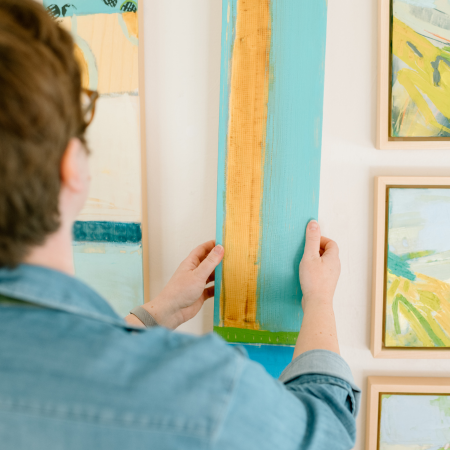
Then I sketch out my design on tracing paper and tape that to the canvas to guide where I apply my shapes. I usually work in two areas at a time, cutting the painted swatches and applying a shape to the first area, and while that is drying I cut and apply a shape to the second area, alternating back and forth.
I’m constantly photographing flowers and plants, and my designs are influenced by those photos. But the actual designs look nothing like the original shots! I manipulate scale, isolate shapes, overlap elements, and build my own composition to fit the canvas. I love to layer silhouettes of florals into my work, as a contrast to the other colorful blossoms and leaves. To me, the silhouettes imply a presence and an absence. It’s a subtle reminder that nature needs to be protected.

What is your favorite, or the most rewarding, part of your creative process?
I love the hands-on time in the studio the most!
What is the most challenging part?
The most challenging part is the color palette. Figuring out how to get a pleasing combination of dark and light values, warm and cool colors, all within the target range of hues is difficult. Then, translating the colors from digital to paint is tricky as well.
What does an average day look like for you?
I work in marketing for a health system and I hit the fitness center every day at lunch, so it is late afternoon by the time I’m in the studio. This is why efficiency is so important to my process! I work in the studio about 3-4 hours each day, then eat dinner late with my family and head to bed!

You work with both paint and collaged paper. How did this winning combination take shape? Where do you source paper from? And what is it like finding a balance between the two?
I mostly work with painted paper swatches. It’s been a journey to find this process. The lightbulb really went on when I took a class about color with Mark Eanes. He encouraged us to paint swatches of paper to combine in different color combinations. I learned about color in the class, but I also learned that I loved painting and cutting paper swatches. Suddenly I could envision compositions created this way, and that was the beginning.
I work with lots of paper, but mostly watercolor paper, tracing paper, and marker paper. I make sure the paper I use is acid free, and I source it from local art stores when possible, or sometimes Amazon.
Plants and botanicals are the focus of your work, but they also play a role in your upbringing and family history. Can you describe and elaborate a bit about the meaning behind plants in your work and for you as an artist?
My mother and grandmother were botanical artists. My mom still paints flowers! When my grandmother wasn’t painting, she worked arranging flowers for weddings, restaurants and museums. My grandfather was a botanist by hobby and cross-pollinated lilies to cultivate new varieties (we named our first daughter Lily because of this!). My family had a farm and grew flowers in their fields. Flowers are a big deal in my family, I grew up surrounded by them, understanding how to work with them in a vase and on a canvas.

How does color play a role in your work? Do you often base your color choices off the realistic colors of the flowers you are depicting, or do you push and exaggerate what you see?
Decisions about color are really fundamental to my work. I usually depict flowers in hues that are similar to real life, but I take license with value and saturation. Next, the color of the subject helps determine the color of the background. When transparent layers overlap the subject, they are constructed to complement what is underneath, keeping in mind the whole time that contrast between colors must be used strategically to guide the eye.
While the bulk of your work depicts abstracted florals, you also have a series of more purely abstract pieces. Can you talk a bit about this abstract series, and how it formed in relation to the botanicals? What does each series mean to you in the context of your larger body of work?
Yes, I also have an abstract line of work, and to create it I use a process that is very different from how I make my botanicals. Instead of planning each piece I work directly on the canvas by layering different types of marks and materials. Then I look for connections that happen spontaneously between the shapes, colors and textures. Working this way taught me a lot about composition and I apply that in my botanical work. It’s fun and feels like exercising a different muscle.

Are there any particular artists who have inspired you or to whom you feel connected in some way?
So many! Of course, my mom and grandmother. I think looking at the illustrations of Eric Carle made a big impression on me when I was a child. I’ve always been drawn to the colors Cezanne used. Today, I’m inspired by the work of Anna Carll, Cayce Zavaglia, Rob Szot, Jennifer Candon, Heather Day, Rebecca Tucker, Judy Woods, Tansy Hargan (known on Instagram as @palimpsetparade), and many more.

From your first painting to those you create now, how would you say you’ve grown as an artist?
I’m much more open to experimentation now, and more willing to let go of a design if it isn’t working, no matter how much I’ve invested in it. I also think I have a better understanding of cohesion, depth, and nuance within a composition.
If you could give one piece of advice to yourself as a younger artist, what would it be?
You will receive all kinds of advice from many people. Filter all of it through your own lens of what feels right.
In five words or less, what is your goal as an artist?
Continue growing and creating
What is your favorite flower (or plant), and why?
If I have to pick one, I’d say peonies. I love everything about them. But it’s a tough choice.

Now for something different: Tea or coffee?
COFFEE! COFFEE! COFFEE!
Morning person or night owl?
Neither! I’m up early but don’t really feel energized at first (ahem, coffee!). I do my best work from mid-morning ‘til around 6pm. By nighttime I’m ready for bed.
Books or movies?
Audiobooks and podcasts.
Test the waters or dive in the deep end?
Dive in.
Pineapple pizza or candy corn?
Veggie pizza and tiramisu.
Finally: What’s your favorite place on earth?
Ocracoke, North Carolina.
Explore original works and prints by Jill Haas in her Artist Collection here, or contact us for customized recommendations from an Art Advisor!